To choose the right type of storage or preservation for your herbs, you should ask yourself right at the beginning:
Is the plant a delicate or hard herb?
Enjoy culinary herbs for longer
Keeping fresh
Fresh garden herbs give food a very special taste in summer. But how can you make them last longer? With these tips, it'll work!
Share this tip with friends:
Preparation is everything! In order to preserve your herbs particularly effectively, you should keep a few small things in mind:
After buying or picking, you should first remove any wilted or dry leaves.
If you have a herb bunch, you can shorten the stems a little.
Don't forget to wash carefully! Preferably with cold to lukewarm water.
Dry thoroughly with the help of kitchen paper or a salad spinner.
To choose the right type of storage or preservation for your herbs, you should ask yourself right at the beginning:
Is the plant a delicate or hard herb?

Delicate herbs such as parsley, coriander, dill or mint need a lot of water. So after buying or picking them, you should ideally place them in a glass with about 3 cm of water. If the container is large enough, you can also cover it with Toppit's® cling film before putting it in the refrigerator. You can also let the herbs do particularly well if you dip them in a bowl of water every now and then. Make sure that the herbs are always supplied with water and are not exposed to too many draughts. This way they last up to two weeks

A typical feature of hard herbs are the woody branches, such as rosemary, thyme or oregano. These herbs usually come from warmer regions, so they are less sensitive and require less water. You can first wrap them in damp kitchen paper or simply dip them briefly in water (this way the herbs don't dry out so quickly) and put them in a resealable food storage bag or Toppits® freezer bag. The herbs can be kept fresh and stored in a particularly uncomplicated and space-saving way for up to two weeks.
Even though basil is one of the most popular garden herbs, it requires special treatment in terms of storage. Unlike other tender herbs, basil does not tolerate the cold, so it stays fresh for a maximum of 3-4 days. To prevent the leaves from ending up in the trash, you can easily preserve them. For example, by freezing them in portions. Another option is to soak basil in oil. Simply wash the leaves, cut off the stems, fill a bottle halfway with olive oil, add some sliced garlic and the basil leaves. Fill up with oil, close tightly and let it steep for at least 8 - 10 days. Done!

No space? No problem! Store herbs in a space-saving way
Not everyone has a lot of space in the fridge and can afford to leave several jars of water and herbs in the fridge. But that doesn't have to be the case! Because there are a few simple tricks to keep your favourite herbs fresh in an even more space-saving way.
The following applies: Chop for all you're worth! Because if you cut the freshly harvested herbs into small pieces in advance, you can store them very flexibly. For example, in the Toppits® Zipper® bag in the door shelf of your refrigerator. And the best part? The herbs are ready for use at any time and no longer have to be cut into small pieces while cooking.
Herb ice cubes
Do you have leftover herbs? Instead of throwing them in the bin, you can put finely chopped them in an ice cube tray and carefully fill them with water.
The ready-made herb ice cubes are ideal for using small amounts of herbs and keeping them fresh. You can then simply add them directly to the hot dishes while cooking and thus provide the necessary spice. In principle, however, we recommend freezing the individual herbs separately in the freezer bag for larger quantities, so that they stay fresh even longer.

Herb butter
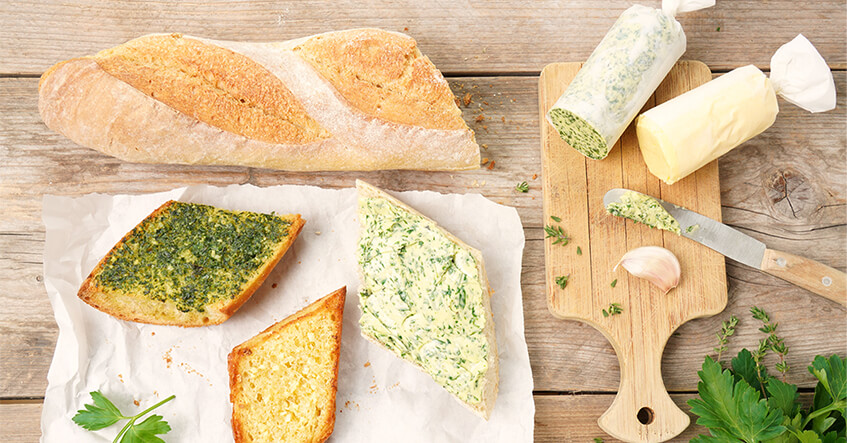
In the form of herb butter, your herbs will stay fresh for up to 12 months!
To do this, wash, dry, chop the herbs and prepare the herb butter. Roll the herb butter, cut it into narrow slices, wrap the pieces individually in toppits® cling film and freeze them in a toppits® freezer bag. This way you can use the butter in portions.
Which herbs are suitable for freezing?
Basically, you can freeze all herbs. Most herb varieties retain their typical spice even after freezing and can be easily preserved. You can find a detailed list of freezer-safe herbs and the appropriate instructions in our article on freezing fresh herbs in the SafeLoc® freezer bag . You can easily check how long the herbs can be kept in the freezer in the Toppits® Foodsaver app .
Which herbs are suitable for drying?
As a rule, all herb varieties with firm leaves can be dried without any problems and convince us with their special taste even when dry. These include herbs such as rosemary, sage, thyme, marjoram, oregano, peppermint, bay leaf and more. You can dry the herbs either in the air or in the oven.
Let it air dry
To air dry the herbs, you should gather them into a compact bouquet. Then you can let them hang upside down from the ceiling. A dark and well-ventilated room would be ideal for this. Drying takes about 8 days, depending on the herb variety and the environment.
Drying in the oven
If you don't have space or time, you can also choose the shorter route with the help of an oven. To do this, spread the herbs next to each other on a tray covered with baking paper (e.g. Toppits® baking paper with a non-slip underside) and dry at a maximum of 40 degrees top and bottom heat for about 5 hours. It is important that the oven remains open a crack. You can achieve this by sticking a wooden spoon into the door, for example.
A herb garden in your own kitchen
Freshly harvested herbs even without your own garden? It's possible! Instead of buying kitchen herbs, you can easily harvest them from your own windowsill. You can find out how to create your own herb garden in mini format here.

With the Toppits® Foodsaver app, you can keep track of your frozen food.
Simply scan the freshness code on the Toppits® freezer bags and save everything in the app.
So you always know what's in the freezer – even when you're on the go.
This saves time, money and prevents food waste.