SafeLoc® Mini

The safe all-purpose bag for at home and on the go

The SafeLoc® Mini from Toppits® are tear-resistant, leak-proof, reusable and ideal for sorting and transporting small items – perfect for household, children & hobbies!


  • Two sizes
  • Secure and practical double closure
  • Versatile household helper for storing and transporting, keeping fresh, freezing
  • Safely stored in the practical assortment box
  • Easy to open thanks to the opening tab
  • Manufactured using recycled residues

SafeLoc® Mini as a helper in everyday life

Tips for using SafeLoc® Mini Bags

The SafeLoc® Mini bags from Toppits® can make your life much easier in many situations. For many small challenges of everyday life, they are very practical companions that can solve many a small problem.


For people interested in handicrafts, the SafeLoc® Mini are a real enrichment, as they can create more order in terms of small parts. Haberdashery such as buttons, rivets and the like no longer accumulate in compartments over the years, but can be stowed away in the best possible way until the next use calls.

Tidying up and sorting with the SafeLoc® Mini bags
The SafeLoc® Mini from Toppits® are also suitable for toy accessories. Game pieces, figures or cards can be neatly separated and stowed away. Long searches or lost accessories are then a thing of the past. With the small SafeLoc® Mini bags, the way is clear for immediate fun.

Auf einer weißen Holzoberfläche liegen bunte Radiergummis in Tierform und verschiedene Süßigkeiten. Ein Safeloc Mini von Toppits ist mit Süßigkeiten gefüllt

Instructions for use

1. Illustration:  Zwei Hände schließen einen Beutel mit Toppits Safeloc Verschluss, indem sie die beiden Seiten des Verschlusses zusammendrücken

1.  

Press the closure together at one corner of the bag and close with two fingers along the guide rail. Leave 2 cm open.

2 Illustration: Eine Hand hält einen Toppits SafeLoc Beutel, während die andere Hand mit einer gleitenden Bewegung den Verschluss entlangfährt, um ihn vollständig zu verschließen

2.  

Place the bag down, stroke out the air with your hand, then close completely.

3. Illustration: Zwei Hände öffnen einen SafeLoc Beutel, indem sie die beiden Seiten des Verschlusses auseinanderziehen

3.  

To open, pull the SafeLoc® closure apart in the middle of the bag with both hands.

Green cable plugged into a white socket on a wall made of lawn

Our contribution towards a circular economy

Some of our Toppits® products are made using recycled resources

We have already taken a step in this direction, as many of our products – such as cling film, SafeLoc® freezer bags and Zipper® bags – are partially made from reprocessed residual materials.

So when you buy them, you are not only helping to keep food fresh for longer, but also contributing to the conservation of valuable raw materials.


Thanks to their protective properties, our Toppits® products also help reduce food waste – very much in line with ‘Save Food’.


In this way, we want to contribute to a circular economy in which materials are reused as much as possible.


Available sizes

Front of Packaging Toppits SafeLoc Mini Pouch

SafeLoc® Mini


Format
9 x 12 cm and 13 x 13 cm


Contents
2 x 20 bags


Answers to your questions

For us, sustainable household items are products that have a very low impact on the environment. To meet this requirement, we are working on fully integrating our entire product portfolio into the circular economy in the future. This means that we will no longer need new fossil raw materials to manufacture our products and the products will be made exclusively from recycled or renewable materials and can be fully recycled or composted after use. You can find out more about our sustainability approach at Toppits® here.


The Toppits® portfolio already includes many products that can be used several times. Our Toppits® freezer bags and zippers® are not only real all-rounders, but can also be reused several times thanks to their robust quality.


We are convinced that it is important for truly sustainable household items to become part of the circular economy. In the circular economy model, existing materials and products are reused and recycled for as long as possible to extend the life cycle of the materials. We therefore not only ensure that our products are made from sustainable resources , but that the products can also be used as raw materials for new products after use. In this way, waste can be reduced to a minimum and resources can be reprocessed.


Does the circular economy avoid plastic waste? 

In the circular economy, plastic waste is a valuable resource for the production of new, sustainable products. Recycling starts at home. For example, if a Toppits® freezer bag has reached its lifespan and is about to be disposed of, it is important to dispose of it properly so that it can be returned to the cycle. If you are not sure how to recycle your Toppits® products properly, contact your local waste management company. Here you can find more information about the importance of recycling.


Are the products more environmentally friendly through recycling?

In order to make our household products more sustainable and environmentally friendly, we strive to use recycled or renewable raw materials in production. By using non-fossil raw materials , we can reduce the use of fossil raw materials such as crude oil and thus make an important contribution to a more sustainable household.


Are ice cube bags sustainable?

Reusable products are an important contribution to the sustainable use of raw materials. Unfortunately, however, reusable solutions cannot yet be used in all areas of the household. This is often due to hygienic reasons, because high hygiene standards apply when processing raw meat, for example.


A sheer lack of space in the freezer compartment can also make the use of disposable items easier and safer. For these reasons, there are also disposable items in our product portfolio. However, our goal is to make these products as sustainable as possible in order to ensure that they are used in a way that does not further pollute the climate.


Why aren't new Toppits products made from old Toppits®  ® products? 

The majority of our products are already made with 35% recycled resources . These resources are, for example, organic residues from the food cycle that are harmless for food storage. This means that some of the raw materials consist of residues in order to reduce the use of petroleum-based raw materials. You can find out more about this topic and the mass balance approach used here.


In addition, the majority of the Toppits® portfolio is recyclable.  According to the current state of the art, no new products with food contact can be made from it, because in order to ensure safety in food contact, the requirements for this type of recycling are even higher. However, if disposed of correctly, the single-origin film of our products could be processed into high-quality new garbage bags, for example.

How sustainable is plastic? Plastic has a bad reputation because it is made from the fossil raw material petroleum or crude gasoline. But we are committed to the sustainable use of plastic products and are always working to make our products more sustainable.


The path to a more sustainable use of plastics

Toppits® is committed to a more sustainable use of plastic. With our sustainable plastic products, we are pursuing the Ideal of the circular economy. In the future, we aim to ensure that all products in our portfolio are made from recycled or renewable resources and are recyclable or compostable after use. Together with our raw material suppliers, for example, we pursue the mass balance approach. This enables the use of plastics made from renewable or recycled raw materials while maintaining high energy and material efficiency. Even after use, our products already contribute to the circular economy: Many of our products are already recyclable.


What exactly are the recycled resources used?

The production of new sustainable Toppits® products is based on processed, organic residues. These come from the food cycle , for example, and can be regenerated into Toppits® products in state-of-the-art recycling processes.


Are the resources harmless to health?

The resources used are completely harmless to health. It is very important to us to continue to guarantee the proven Toppits® quality.


Bio-based plastics as a resource for Toppits® products

It remains a disposable product - is that sustainable? 

Of course, the sustainability of plastic bags is debatable, but we already offer many products that can be used several times: freezer bags and zippers® can be used again and again by washing them out.


Regardless, we believe that the transition to the circular economy is a significant contribution to a more sustainable world. An important part of the circular economy is recycling, i.e . the processing of waste for a new purpose. We want our products not only to be made with sustainable resources, but also to be able to serve as raw materials for new products at the end of their use. You can find more about the circular economy here. 

We believe that the circular economy is a significant contribution to a more sustainable world. An important part of the circular economy is recycling, i.e. the preparation of recyclable materials for a new purpose. We want our products not only to be made from sustainable resources, but also to be able to serve as raw materials for new products at the end of their use, thus optimally integrating into the recycling cycle.


Recycling as part of the circular economy 

Three factors play an important role in ensuring recycling as part of the circular economy: the progress of recycling technologies, the possibility of recyclable disposal and the recyclability of the materials used. As a producer, we have the most influence on the latter and are therefore working particularly on the recyclability of our own products.


Recyclable materials 

Whether a product is recyclable currently depends in particular on its material composition. The purer the material, the better it can be recycled. This applies, for example, to the aluminum we use in our aluminum foil. For many plastics, this is somewhat more complex and can be roughly divided into three groups.


Recycling of plastics 

The first group is plastics, which are easy to sort and recycle and are therefore primarily used.


The plastics in the second group could theoretically be recycled, but due to their low abundance, they will not.


The plastics that cannot be recycled because their chemical and physical properties do not yet allow this form the third group. We therefore classify only the first group as recyclable.


Recycling at Toppits®

An example of the first group of plastics is the material in our cling film: Some cling films are made of multi-layer films that are difficult to recycle or non-recyclable plastics are used. The Toppits® cling film is made of polyethylene, a highly recyclable plastic that requires few additives.


We are constantly working to increase the proportion of easily sortable and recyclable plastics in our portfolio and, in turn, to reduce poorly recyclable plastic products, indeed all materials that are difficult to recycle. In this way, we want to promote the circular economy and make our contribution to reducing the incineration or landfilling of valuable raw materials.


Recycling of aluminium products

All Toppits® aluminium products are fully recyclable, as the aluminium used is particularly pure and not contaminated with other materials. Since aluminium is a very valuable material, the collection and recycling of aluminium is very important not only for the circular economy, but also from an economic point of view. In addition, using recycled material can save a lot of energy compared to new aluminium.


You can support recycling when disposing of aluminium:


  • Press your aluminum foil or aluminum shell together: this will help sort the material
  • Ask your local disposal company how best to dispose of the products
  • Heavily contaminated material (for example, completely covered with adhering food residues) should be disposed of in the residual waste


Tips to support our recycling processes 

You can also support us in this: Just as important as the selection of recyclable materials is the correct disposal of our products after use. Throughout Europe, not only every country, but also every region has different disposal systems and guidelines. The countries also treat the topic of recycling differently. Find out about the local recycling recommendations from your waste management company or district administration and dispose of our products accordingly so that as much as possible can be recycled!

Have more questions? Check out our FAQs to find answers.


To the FAQs


You might also be interested in these products

Freezer bags: How to avoid freezer burn | Toppits®

Toppits® freezer bags reliably protect against freezer burn. Ideal for freezing fruit, vegetables, meat and bread. » Learn more!

Silicone lids: keep fresh and reuse | Toppits®

Toppits® silicone lids: The clever alternative to cling film! ✓ Reusable & flexible. ✓ For refrigerator & microwave. » Learn more!

Ice Cube Bags – Make Round Ice Cubes | Toppits®

Toppits® Ice Cube Bags: Perfect for round ice cubes! ✓ Easy to fill & remove. ✓ Made using processed residues » Discover now!

You might also be interested in these recipes & tips

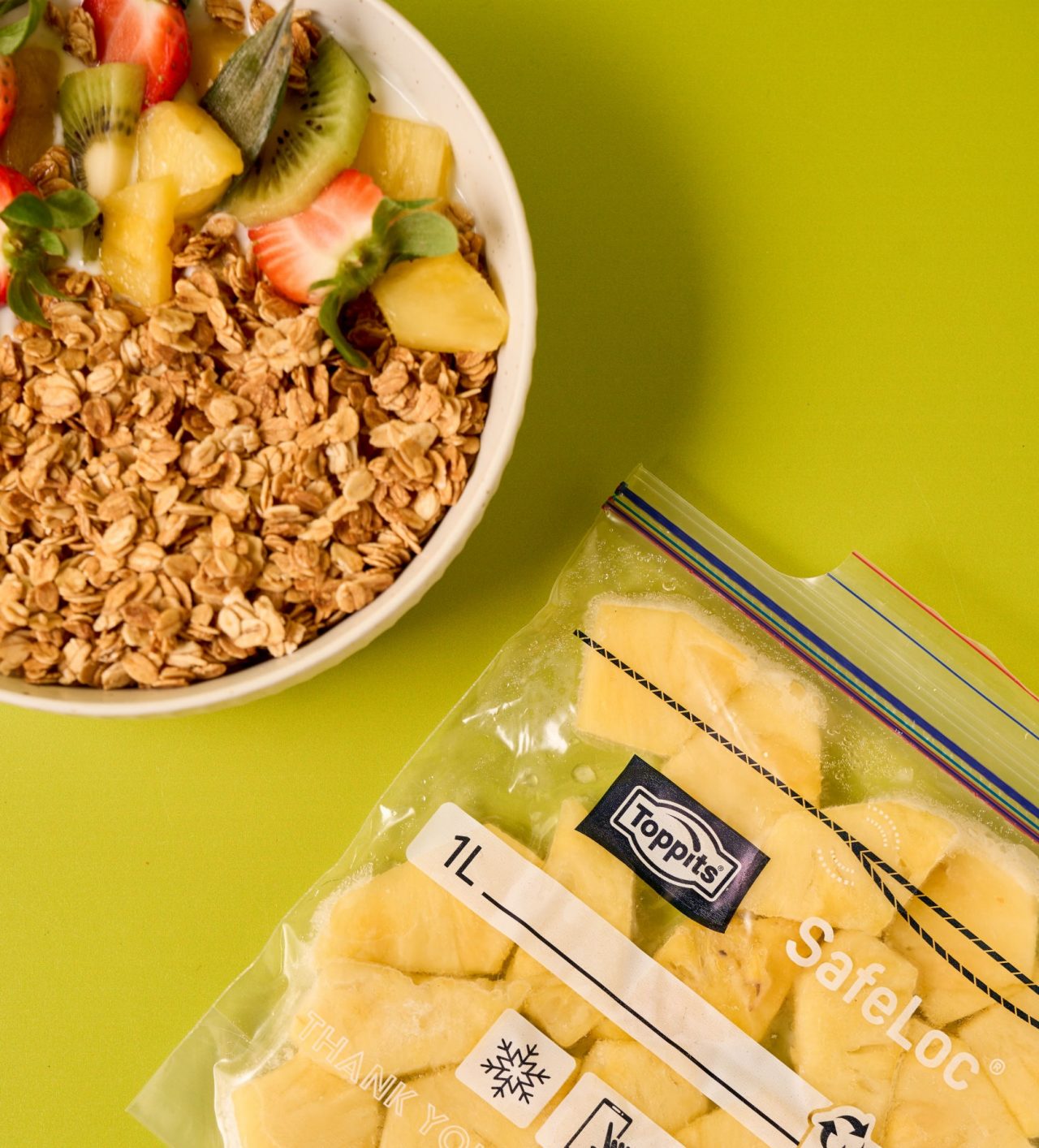
How to Freeze Pineapple: Instructions, Tips & Tricks | Toppits®

Freezing pineapples properly: ✓ Step-by-step instructions, ✓ Tips for preparation and shelf life. » How to keep it fresh and delicious!

Tips against food waste | Toppits®

Find out how you can avoid food waste in everyday life with simple tips and tricks. Sustainable & smart! » Learn more
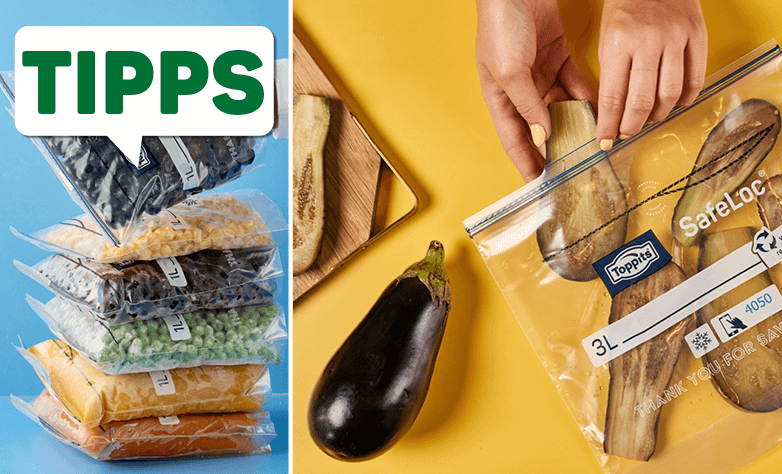
Ein Stapel gefüllter Toppits SafeLoc Beutel mit verschiedenen gefrorenen Lebensmitteln steht neben einer Person, die gebratene Auberginenscheiben in einen weiteren Beutel legt. Oben links ist ein „TIPPS“-Symbol zu sehen

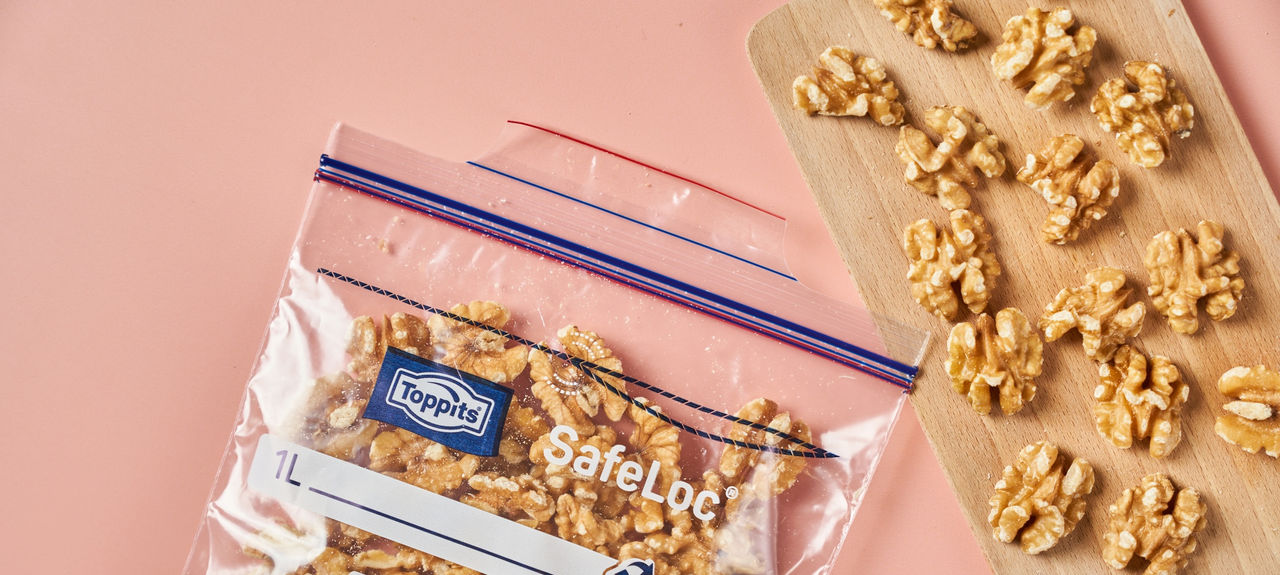
Freezing nuts: How to keep them fresh longer | Toppits®

How to freeze nuts properly for a long shelf life ✓ Tips for preparing and storing different types of nuts ✓ Avoid freezer burn. Discover our tricks now! » Learn more!
Toppits SafeLoc Beutel gefüllt mit Walnusskernen liegt neben Holzbrett auf rosa Fläche.